
Paying Tribute to One of Siquijor's Ancient Healing Traditions: Halad
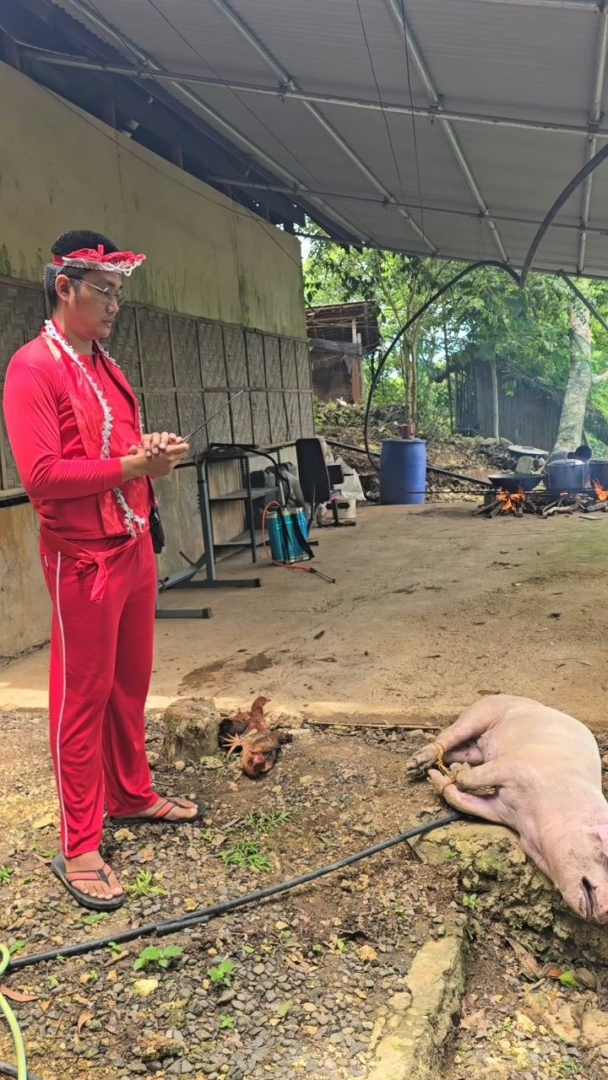
Siquijor has long been recognized as Healing Island. For generations, different lineages of healers have preserved and passed down their prayers, herbs, rituals, and spiritual practices. Together, these traditions have shaped the island's identity and continue to attract people seeking healing and spiritual guidance.
This article is my small contribution to help preserve one of these traditions—the ritual offering.
A Tradition Entrusted to Me
Although I was not born in Siquijor, it is a great honor for me to be accepted into a unbroken lineage of traditional healers of Siquijor. My teachers entrusted me with their knowledge, rituals, and the responsibility to help preserve this ancient tradition for future generations.
I am not sharing this to show that one tribe is superior to another. Rather, I aim to honor my teachers and contribute to preserving the rich healing heritage that has made Siquijor known around the world.
This is me praying to the animals before performing the ritual sacrifice on a Friday morning.
What is the Sacrifice?
In our family of physicians, the ritual offering is a sacred ritual offering.
Nowadays, many people associate sacrifice with rituals against witchcraft or other evil spiritual influences. But in the tradition I inherited, sacrifice also plays an important role in healing. It can be performed for people believed to be suffering from spiritual attack, as well as as an expression of repentance, gratitude, purification, and a request for mercy, protection, and healing from God.
It is never done carelessly or for show. It is done with prayer, humility, respect, and sincere care.
An Ancient Tradition Found in Many Cultures
Although halad is part of my Siquijor lineage, the concept of sacred offering is not unique to Siquijor.
Throughout history, many civilizations in different parts of the world have practiced ritual offerings as expressions of worship, gratitude, covenant, repentance, purification, and healing. While the beliefs and practices of each culture and religion vary, they reflect humanity's long-standing desire to connect with the Divine and express their devotion.
By understanding this broader context, we can better understand that sacrifice is part of a very old tradition of humanity and not just a custom that is often misunderstood.
The Beliefs of Our Tradition
Each healing tradition has its own understanding of how healing occurs.
One of the main beliefs passed down through our lineage is True spiritual healing comes with a price.—a concept that can be called exchange of spiritual strength or energy.
According to our tradition, if the entire spiritual burden of healing is carried by the healer alone, his own life force is gradually depleted. In our clan, it is believed that this can result over time in physical weakness, repeated illness, misfortune, tooth loss, and ultimately a shorter life.
Because of this, the ritual offering is understood as a sacred offering in which the spiritual burden is borne by the offering rather than by the healer. Our teachers believe that in this way the healer can continue to serve many for a long time without personally sharing the full spiritual burden of each healing.
These are beliefs unique to my lineage, and I recognize that other traditions may have different views on healing.
Experiences in My Ministry
Over the years, I have been given the opportunity to help many people who have come to me after experiencing problems they cannot explain or who have not recovered despite the various attempts they have made.
In our tradition, some of these are understood as spiritual illnesses or spiritual attacks. Many of them have shared that they have experienced healing, peace, restoration, or deliverance after prayer, consultation, and where appropriate, the practice of ritual offering.
I understand that other people may interpret these experiences differently. I am simply sharing them as part of my own journey and the tradition entrusted to me.
Respect for Other Physicians
The strength of Siquijor has never depended on a single healer or a single tradition.
Each clan has an important contribution—whether it be herbal medicine, massage, prayer, faith healing, spiritual rituals, or other ancient practices.
It is not the purpose of this article to say that one tradition is better than another. Instead, I invite everyone to appreciate the diversity of healing traditions that collectively make up Siquijor's identity as Healing Island.
For Our Vegan and Vegetarian Friends
I also recognize that there are readers who are vegan or vegetarian, and I sincerely respect the concern for the animals that often make up their livelihood.
It is not my intention to challenge or belittle their beliefs.
In my healing tradition, the ritual offering is considered a sacred religious offering and not an act of cruelty. The animal is treated with respect and gratitude, efforts are made to minimize its suffering as much as possible, and it is not wasted.
I understand that not everyone believes the same way we do, and I respect that difference. My goal is to understand this tradition within its own spiritual and cultural context.
Preserving a Living Legacy
Many traditions are lost not because they have no value, but because they are not recorded or shared.
Whether we look at it from a faith, culture, history, or anthropology perspective, I believe it is only right to remember and preserve these traditions as part of Siquijor's rich heritage.
We don't have to share the same beliefs to respect each other's traditions.
May God bless every faithful healer who serves with compassion, and may the healing traditions of Siquijor continue to live on and inspire generations to come.